Complete Guide to Divorce in Malaysia (2026)
Everything you need to know about getting divorced in Malaysia — civil and Syariah systems explained. Grounds, process, costs, custody, property, maintenance, and legal aid. Updated for 2026.
Malaysia records roughly 60,000 divorces every year. If you are reading this, you may be one of the thousands of Malaysians facing one of life's most difficult legal processes. This guide is here to help you understand your rights, your options, and what to expect — clearly and honestly.
What makes Malaysia unique is that two completely separate legal systems handle divorce. Which system applies to you depends entirely on your religion. This guide covers both so that every Malaysian can find the information they need in one place.
Key Point: This guide is for general information only. It is not legal advice. Laws and fees change — always consult a qualified Malaysian lawyer for your specific situation.
Table of Contents
- Malaysia's Dual Divorce System
- Civil Divorce (Non-Muslim)
- Islamic Divorce (Muslim)
- Children: Custody and Maintenance
- Property Division
- Spousal Maintenance
- Domestic Violence and Divorce
- Finding a Lawyer
- Frequently Asked Questions
- Key Takeaways
Malaysia's Dual Divorce System
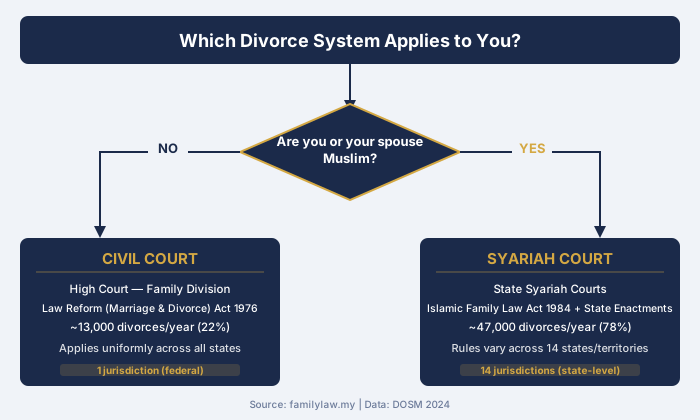
Malaysia operates two parallel legal systems for family law matters. The system that applies to you is determined by one factor: whether the parties are Muslim or non-Muslim.
| | Civil System | Syariah System | |---|---|---| | Who it applies to | All non-Muslims | All Muslims | | Governing law | Law Reform (Marriage and Divorce) Act 1976 (LRA) | Islamic Family Law Act 1984 + state enactments | | Court | High Court, Family Division | Syariah Court (state-level) | | Number of jurisdictions | 1 (federal) | 14 (13 states + Federal Territories) | | Annual divorces | ~13,000 (approx. 22%) | ~47,000 (approx. 78%) |
The constitutional basis for this dual system comes from Article 121(1A) of the Federal Constitution, which separates civil court and Syariah court jurisdiction. In practice, this means civil courts cannot hear matters that fall under Syariah jurisdiction, and Syariah courts have no authority over non-Muslims.
Key Point: If both spouses are non-Muslim, you go through the civil courts. If both spouses are Muslim, you go through the Syariah courts. When one spouse converts to Islam during a civil marriage, special rules apply under Section 51 of the LRA — see our conversion guide for details.
Civil Divorce (Non-Muslim)
Who Qualifies
Civil divorce in Malaysia is governed by the Law Reform (Marriage and Divorce) Act 1976 (LRA). It applies to:
- All non-Muslims in Malaysia, regardless of race or nationality
- Marriages solemnized and registered under the LRA
- Marriages validly contracted before the LRA came into force (these are deemed registered under the Act)
At least one party must be domiciled or resident in Malaysia at the time of filing (Sections 48-49).
The 2-Year Rule
You generally cannot petition for divorce until at least 2 years have passed since your marriage (Section 50).
There are two exceptions:
- Exceptional hardship — A judge may permit an earlier petition if there are exceptional circumstances, hardship suffered by the petitioner, or where the interests of a child require it
- Conversion to Islam — If one spouse converts, the non-converting spouse may file after just 3 months (Section 51)
Two Routes: Joint Petition vs Single Petition
There are two ways to get divorced under the civil system. Which route you take depends on whether both parties agree.
Route A: Joint Petition (Mutual Consent) — Section 52
A joint petition is available when both spouses agree to end the marriage. It is faster, cheaper, and far less stressful than a contested divorce.
Requirements:
- Both parties freely consent to the dissolution
- The marriage has lasted at least 2 years
- Proper provision has been made for any children (support, custody)
- Parties have agreed on ancillary matters (property, maintenance)
Advantages:
- No need to prove "irretrievable breakdown"
- No compulsory counselling sessions at JPN
- Both spouses can share one lawyer
- Fewer court appearances
- Lower legal costs
- Typically resolved in 3 to 6 months
Route B: Single Petition (One Party Files) — Section 53
When one spouse wants a divorce and the other does not agree (or will not cooperate), the petitioner must file a single petition and prove that the marriage has irretrievably broken down.
Grounds for Divorce (Section 54)
Under a single petition, the court requires proof of at least one of these grounds:
| Ground | What You Must Show | |---|---| | Adultery | Your spouse committed adultery and you find it intolerable to live with them | | Unreasonable behaviour | Your spouse has behaved in a way that you cannot reasonably be expected to live with them | | Desertion (2 years) | Your spouse deserted you for at least 2 continuous years before the petition | | Separation (2 years, with consent) | You have lived apart for at least 2 years and your spouse consents to the divorce | | Separation (5 years, no consent needed) | You have lived apart for at least 5 years — your spouse's consent is not required |
Step-by-Step Process
Joint Petition Timeline (3-6 months):
- Both parties instruct a lawyer (can share one)
- Lawyer drafts the joint petition setting out agreed terms
- Joint petition filed with the High Court (Family Division)
- Court hearing — judge confirms consent is voluntary and provisions are fair
- Decree nisi granted (provisional divorce order)
- 3-month waiting period (a grace period where either party could object)
- Application for decree absolute
- Decree absolute granted — marriage is legally dissolved
Single Petition Timeline (9-12+ months):
- Petitioner instructs a lawyer
- 3 compulsory counselling sessions at JPN (National Registration Department) — these are free
- If reconciliation fails, JPN issues a "failure to reconcile" certificate
- Lawyer files single petition with the High Court
- Respondent is served and may contest
- Court hears evidence and submissions
- If satisfied, court grants decree nisi
- 3-month waiting period
- Application for decree absolute
- Decree absolute granted — marriage is legally dissolved
Key Point: The decree nisi is not your final divorce. You must wait 3 months and then apply for the decree absolute. Only after the decree absolute is granted is your marriage legally over.
What Does a Civil Divorce Cost?
| Item | Estimated Cost (RM) | |---|---| | Court filing fees (joint petition) | ~RM 868 | | Court filing fees (single petition) | ~RM 800 - 1,200 | | Lawyer fees — uncontested / joint | RM 3,000 - 8,000 | | Lawyer fees — contested / single | RM 8,000 - 50,000+ | | Lawyer fees — complex (custody + property disputes) | RM 30,000 - 100,000+ | | Private investigator (if needed for adultery evidence) | RM 3,000 - 10,000+ | | JPN counselling sessions | Free |
Costs vary significantly depending on the complexity of your case, your lawyer's seniority, and your location. Always ask for a detailed fee quotation before engaging a lawyer. For a detailed breakdown, see our full guide to divorce costs in Malaysia.
Islamic Divorce (Muslim)
Overview of the Syariah System
Muslim divorces in Malaysia are handled by the Syariah courts, which operate at the state level. This means there are 14 separate jurisdictions across the country (one for each of the 13 states, plus the Federal Territories). Each state has enacted its own Islamic Family Law, and there are meaningful differences between them.
The Syariah court system has approximately 102 courts nationwide, coordinated through the e-Syariah electronic case management system operated by JKSM (Jabatan Kehakiman Syariah Malaysia).
Key Point: The rules for Islamic divorce can differ depending on which state you are in. What applies in Selangor may not apply in Kelantan. If you are unsure which state's law governs your case, a Syariah lawyer can advise you.
Types of Islamic Divorce
There are several types of divorce available under Islamic family law. Which type applies depends on who is initiating the divorce and the circumstances.
| Type | Who Initiates | How It Works | Typical Duration | |---|---|---|---| | Talaq | Husband | Husband pronounces divorce before the court. Talaq 1 or 2 is revocable during iddah (waiting period). Talaq 3 is irrevocable. | Relatively fast if through court | | Khuluk | Wife (with husband's agreement) | Wife offers compensation (typically returning the mahr/dowry) in exchange for divorce. Requires the husband's agreement. | Moderate | | Fasakh | Wife (court petition) | Wife petitions the court on specific fault grounds (12 grounds in most states, including abuse, neglect, desertion, and impotence). | 6 months to several years | | Ta'liq | Wife (conditional) | Based on conditions written into the marriage contract at the time of nikah. Wife must prove a condition was breached. | Moderate | | Li'an | Husband | Husband accuses wife of adultery through prescribed oaths. Both parties swear oaths. If both complete them, marriage is dissolved permanently. | Rare | | Hakam | Either party (arbitration) | Family arbitrators (one from each side) are appointed by the court. Often faster than fasakh. Underutilized — many are unaware this option exists. | Faster than fasakh |
Important statistic: According to JKSM data from 2015-2019, 90% of Syariah dissolution cases were filed by the wife.
Talaq: The Husband's Right to Pronounce Divorce
Talaq is the husband's unilateral right to pronounce divorce. In Malaysia, while the husband retains this right, he is required to do so before the Syariah court. Pronouncing talaq outside of court is a Syariah criminal offence and must be reported within 7 days.
- Talaq raj'i (revocable) — Talaq 1 or 2. The husband may revoke the divorce during the iddah period (approximately 3 months) through rujuk (reconciliation)
- Talaq ba'in (irrevocable) — Talaq 3 is final. The couple cannot remarry unless the wife first marries and divorces another man
Fasakh: When the Wife Needs Court Intervention
Fasakh is the route available to a wife who needs to petition the court for divorce on fault grounds. Most states recognise 12 grounds, including:
- Husband's whereabouts unknown for more than 1 year
- Failure to maintain for more than 3 months
- Husband imprisoned for more than 3 years
- Cruelty (habitual assault, forcing wife into prostitution, disposing of wife's property)
- Impotence or inability to consummate the marriage
- Insanity for more than 2 years
Key Point — State Variation Warning: Not all states provide the same protections. Kedah, Perak, and Kelantan recognise only 4-5 grounds for fasakh. Critically, in Kedah, wife abuse is not listed as a ground for fasakh. This is a significant gap that affects women's access to divorce in those states.
The Sulh (Mediation) Process
Since 2001, Syariah courts have used Sulh — a structured mediation process conducted by trained Syariah mediators. If both parties reach agreement through Sulh, the court endorses the settlement. If Sulh fails, the case proceeds to full trial.
What Does a Syariah Divorce Cost?
| Type | Estimated Cost (RM) | |---|---| | Uncontested (talaq by mutual agreement) | RM 1,000 - 5,000 | | Contested (fasakh / khuluk) | RM 5,000 - 50,000+ | | Custody dispute (hadhanah) | RM 3,000 - 15,000 | | Maintenance claim (nafkah) | RM 1,000 - 5,000 |
For a full comparison of Syariah family law across all 14 jurisdictions, see our state-by-state comparison guide.
Children: Custody and Maintenance
Custody and child maintenance are among the most emotionally difficult aspects of divorce. Both the civil and Syariah systems prioritize the welfare of children, but they approach custody differently.
Civil Custody (Non-Muslim)
Under Section 88 of the LRA, the paramount consideration in all custody decisions is the welfare (best interests) of the child. This overrides all other factors.
Factors the court considers:
- The welfare of the child (primary factor)
- Wishes of both parents
- The child's own wishes (if old enough to express an independent opinion)
- Maternal presumption — a rebuttable presumption that a child under age 7 should be with the mother
- Stability of proposed living arrangements
- Fitness of each parent (moral, physical, emotional capacity)
- Financial capacity of each parent
Types of custody orders:
| Type | Description | |---|---| | Sole custody | One parent has full legal custody; the other has access/visitation rights | | Joint custody | Both parents share decision-making, but the child may primarily live with one parent | | Split custody | Different children placed with different parents (rare) |
The non-custodial parent is generally entitled to reasonable access (visitation), including weekends, school holidays, and special occasions.
Syariah Custody (Hadhanah)
Under Islamic family law, custody is called hadhanah. The mother generally has presumptive priority for children below the mumayyiz age (age of discernment):
- Most states: 7 years for both boys and girls
- Selangor: 7 years for boys, 9 years for girls
Once a child reaches mumayyiz age, the court may ask the child's preference, though it is not automatically binding.
Key Point — Hadhanah vs Wilayah: In the Syariah system, there is a critical distinction between hadhanah (physical custody, generally awarded to the mother) and wilayah (legal guardianship, which remains with the father unless revoked by court). This means the father retains decision-making authority over schooling, medical consent, passports, and religious education — even when the mother has day-to-day physical custody.
Child Maintenance
In both systems, both parents have an obligation to support their children financially.
- Civil law: Child maintenance covers accommodation, clothing, food, and education. It continues until the child reaches 18 years of age, or longer if the child is pursuing further education or is incapacitated (Section 92, LRA)
- Syariah law: Child maintenance (nafkah anak) is primarily the father's obligation and continues until the child reaches adulthood or marries
There is no fixed formula for calculating child maintenance in either system. The amount depends on the child's needs and the parent's financial means.
For a full guide to custody rights, see our custody and access guide.
Property Division
Civil Property Division (Section 76, LRA)
Upon granting a divorce, the civil court has the power to order the division of assets acquired during the marriage.
The court starts with an inclination towards equality (50:50) and then adjusts based on:
- Financial contributions — money, property, or work towards acquiring assets
- Non-financial contributions — looking after the home, caring for the family (recognised since the 2017 amendment)
- Debts owed by either party for their joint benefit
- Needs of the children
- Duration of the marriage, conduct of the parties, standard of living, and future earning capacity
Key Point: A 50:50 split is not automatic. Courts apply a "broad brush" approach and have ordered divisions ranging from 50:50 to 90:10, depending on the circumstances. Marriage is not treated as a business arrangement.
Syariah Property Division (Harta Sepencarian)
In the Syariah system, matrimonial property is called harta sepencarian (jointly acquired property). The court distinguishes between:
- Joint-effort assets — property acquired through the efforts of both spouses
- Separate property (harta pusaka) — property owned before the marriage or inherited
The typical division for harta sepencarian is:
- 1/3 to 1/2 for the non-working (homemaker) spouse
- 1/2 when both spouses contributed financially
| Aspect | Civil (Section 76) | Syariah (Harta Sepencarian) | |---|---|---| | Starting point | Inclination towards equality | Typically 1/3 to 1/2 for non-financial contributor | | Non-financial contributions | Recognised since 2017 amendment | Recognised under Islamic jurisprudence | | Pre-marital assets | Generally excluded unless commingled | Generally excluded | | Court discretion | Broad | Broad, guided by Islamic principles |
For more detail, see our property division guide.
Spousal Maintenance
This is one of the most significant differences between the civil and Syariah systems.
Civil Spousal Maintenance
Under Section 77 of the LRA, the court may order a husband to pay maintenance to his wife or former wife. This maintenance can be ongoing or indefinite — it does not automatically end after a set period.
Maintenance ends upon:
- Remarriage of the wife
- Death of either party
- Variation by the court
The court considers the means and needs of both parties, standard of living during the marriage, age, duration of marriage, and contributions to the family (Section 78).
Syariah Spousal Maintenance
In contrast, post-divorce maintenance under Syariah law is limited:
- Nafkah iddah — maintenance during the iddah (waiting period), approximately 3 months. This is mandatory regardless of who initiated the divorce
- Mutaah — a consolatory lump-sum payment determined by the court, based on the husband's means and the duration of the marriage. This is a one-off payment, not ongoing support
| Aspect | Civil | Syariah | |---|---|---| | Duration | Can be ongoing / indefinite | Limited to iddah (~3 months) + one-off mutaah | | Form | Monthly payments, lump sum, or both | Nafkah iddah (monthly during iddah) + mutaah (lump sum) | | Ends upon | Remarriage, death, or court variation | End of iddah period |
Key Point: This difference means that a non-Muslim wife may receive spousal support for years or even indefinitely, while a Muslim wife's direct spousal maintenance typically ends within a few months of the divorce. Muslim women's financial protection relies more heavily on harta sepencarian (property division) and mutaah.
Domestic Violence and Divorce
Domestic violence is, tragically, a leading factor in Malaysian divorces. The Domestic Violence Act 1994 (DVA) applies to all Malaysians regardless of religion and was significantly strengthened by 2017 amendments.
What Counts as Domestic Violence
The definition includes:
- Physical violence or threat of physical violence
- Forcing someone to do something against their will
- Confinement or detention
- Destruction of property
- Financial abuse — dishonest misappropriation of property (added 2017)
- Threats intended to cause fear (added 2017)
- Communication intended to insult modesty (added 2017)
Protection Orders
If you are experiencing domestic violence, there are three types of protection orders available:
| Order | Applied To | How Fast | How Long It Lasts | |---|---|---|---| | Emergency Protection Order (EPO) | Social Welfare Department | Issued within 2 hours; no police report needed | 7 days | | Interim Protection Order (IPO) | Court | During police investigation | Until investigation complete | | Protection Order (PO) | Court | During criminal proceedings | Up to 12 months (renewable once) |
Since 2017, all domestic violence offences are seizable — meaning police can arrest without a warrant.
How DV Relates to Divorce
- Domestic violence constitutes "unreasonable behaviour" under Section 54 of the LRA, which is a valid ground for divorce in the civil system
- In the Syariah system, cruelty (including habitual assault) is a ground for fasakh in most states
- A protection order does not itself dissolve a marriage, but it provides immediate safety while divorce proceedings are underway
- Evidence of domestic violence is relevant to custody decisions — a court may find a violent spouse unfit for custody
Key Point: If you are in immediate danger, call the police (999) or the Women's Aid Organisation crisis line (03-7956 3488). You do not need a lawyer to obtain an Emergency Protection Order — go directly to the nearest Social Welfare Department office.
For more information, see our domestic violence guide.
Finding a Lawyer
The Malaysian Bar Council maintains a searchable directory of all admitted civil lawyers in Malaysia.
What to Look For
- Specialisation — Look for a lawyer who focuses on family law, not a generalist handling it on the side. For Syariah matters, you need a Peguam Syarie (Syariah lawyer) who is separately qualified
- Experience with your type of case — Contested custody disputes require different skills than a simple joint petition
- Communication — You need a lawyer who explains things clearly, responds to your messages, and keeps you informed
- Location — For civil divorce, the case is heard in the High Court. For Syariah divorce, it is heard in the state where the marriage was registered or where the wife resides
- Comfort — Divorce is personal. You should feel comfortable with your lawyer
Fee Structures
| Structure | How It Works | Common For | |---|---|---| | Fixed fee | One price for the entire case | Uncontested / joint petition divorces | | Hourly rate | Charged per hour of work | Contested cases, complex disputes | | Retainer | Upfront deposit drawn down as work is done | Most contested cases | | Stage-based | Different fees for each stage (filing, hearing, appeal) | Some firms |
Always ask for a written fee agreement before engaging any lawyer. Ask specifically about disbursements (court fees, process server fees, photocopying) as these are often charged separately.
Legal Aid Options
If you cannot afford a private lawyer, there are several options:
| Provider | Who Qualifies | What They Offer | |---|---|---| | JBG (Government Legal Aid) | Income below RM25,000/year (free) or RM25,001-50,000/year (subsidized) | Legal advice, mediation, court representation | | Bar Council Legal Aid Centres (LAC) | Disposable income below RM500/month (single) or RM900/month (married) | 15 centres across Malaysia; volunteer lawyers | | WAO (Women's Aid Organisation) | Women experiencing domestic violence | Protection orders, legal referrals, shelter, Legal Aid Fund | | SIS Telenisa | Muslim women | Free phone legal advisory — over 15,000 women helped in 20+ years | | WCC Penang | All | 2 centres, services in 5 languages |
For help finding the right lawyer, see our lawyer directory.
Frequently Asked Questions
How long does a divorce take in Malaysia?
For non-Muslims, a joint petition (mutual consent) typically takes 3 to 6 months. A contested single petition takes 9 to 12 months or longer, depending on complexity. For Muslims, the timeline varies by divorce type — a talaq through court can be relatively fast, while a contested fasakh can take anywhere from 6 months to several years.
Can I get divorced if my spouse does not agree?
Yes. Non-Muslims can file a single petition under Section 53 of the LRA if they can prove the marriage has irretrievably broken down. After 5 years of separation, your spouse's consent is not required at all. Muslim wives can file for fasakh (court annulment) or ta'liq (breach of marriage conditions) without the husband's consent.
How much does a divorce cost in Malaysia?
Costs range widely. An uncontested civil divorce may cost RM 3,000 to 8,000 in total. A contested divorce with custody and property disputes can exceed RM 50,000 to 100,000+. Syariah divorces tend to be less expensive, starting from RM 1,000 to 5,000 for uncontested matters. See our full cost breakdown.
Do I have to wait 2 years before I can file for divorce?
Under the civil system, yes — Section 50 of the LRA generally requires 2 years of marriage before a petition can be filed. Exceptions exist for exceptional hardship or when a spouse converts to Islam (3-month wait only). The Syariah system does not have the same strict 2-year minimum, though rules vary by state.
Will I get 50% of the property?
Not necessarily. In the civil system, the court starts with an inclination towards equality but adjusts based on each spouse's financial and non-financial contributions, debts, and the needs of the children. In the Syariah system, the homemaker spouse typically receives 1/3 to 1/2 of harta sepencarian. There is no automatic 50:50 formula in either system.
What if my spouse converts to Islam during our marriage?
This is one of the most complex situations in Malaysian family law. The civil marriage is not automatically dissolved. Under Section 51 of the LRA, the non-converting spouse may petition for divorce in the civil court after a 3-month waiting period. The 2017/2018 amendments allow both parties to apply for mutual divorce under Section 51. For children's conversion, the landmark Indira Gandhi case (2018) established that both parents must consent before children can be converted.
Can a father get custody?
Yes. While both the civil and Syariah systems have a presumption that young children (under 7) should be with the mother, this presumption is rebuttable. If the father can demonstrate that the child's best interests are better served by being in his custody, the court can award custody to him. Fathers are commonly granted access rights (visitation) even when custody is awarded to the mother.
Is there free legal help available?
Yes. The government's JBG programme provides free legal aid for individuals earning below RM25,000/year. The Bar Council operates 15 Legal Aid Centres across Malaysia. NGOs including WAO, SIS Telenisa, and WCC Penang provide targeted support, particularly for women experiencing domestic violence. See our legal aid guide for the full list.
Key Takeaways
Summary: What Every Malaysian Should Know About Divorce
Two systems, one country. Non-Muslims divorce through the civil courts under the LRA 1976. Muslims divorce through the Syariah courts under state-level Islamic family law. Know which system applies to you.
Mutual consent is fastest and cheapest. If both parties agree, a joint petition (civil) or mutual talaq (Syariah) is far quicker and less expensive than a contested divorce.
The 2-year rule applies to civil divorces. You generally cannot file until 2 years after marriage, with limited exceptions.
Children come first. Both systems prioritize the welfare of the child above all else. Mothers have a presumptive advantage for young children, but this is not absolute.
Property is not automatically 50:50. The court has broad discretion in both systems. Contributions (financial and non-financial) matter.
Spousal maintenance differs dramatically. Civil maintenance can be indefinite. Syariah maintenance is limited to the iddah period (~3 months) plus a one-off mutaah payment.
State variations matter for Muslims. Syariah family law differs across 14 jurisdictions. Some states have significantly fewer protections than others.
Legal aid exists. If you cannot afford a lawyer, free and subsidised help is available through JBG, Legal Aid Centres, and NGOs.
Domestic violence support is immediate. An Emergency Protection Order can be issued within 2 hours, without a police report, through the Social Welfare Department.
Get proper legal advice early. A single consultation with a qualified family lawyer can save you months of confusion and thousands of ringgit in mistakes.
This article was last updated on 1 February 2026. Statistics are sourced from the Department of Statistics Malaysia (DOSM), JKSM, and the Malaysian Bar. Laws and fees are subject to change. For the latest information, consult a qualified Malaysian family lawyer.
Need help? Find a family lawyer near you or explore our legal aid directory.
FamilyLawMY Editorial Team
Researched and written by our team of legal researchers with expertise in Malaysian civil and Syariah family law. All content is fact-checked against primary legislation, court judgments, and official government sources.
About our editorial process · Last reviewed 1 February 2026
Disclaimer: This article is for general information only and does not constitute legal advice. Laws and fees change — always consult a qualified Malaysian lawyer for your specific situation.
Related Articles
Cara Memfailkan Permohonan Cerai di Mahkamah Sivil Malaysia (2026)
Panduan lengkap cara memfailkan perceraian di Mahkamah Sivil Malaysia untuk bukan Islam. Merangkumi syarat kelayakan, borang-borang, kos pemfailan, proses langkah demi langkah, dan masa yang diperlukan.
Berapa Kos Perceraian di Malaysia? Panduan Lengkap (2026)
Pecahan kos perceraian yang lengkap di Malaysia untuk 2026 — kos mahkamah, yuran peguam, kos tersembunyi, dan pilihan bantuan guaman percuma. Merangkumi perceraian sivil dan Syariah.
Divorce While Pregnant in Malaysia: Your Legal Rights Explained
Can you file for divorce while pregnant in Malaysia? This guide covers civil and Syariah law, custody implications, child maintenance before birth, and what to expect during proceedings.